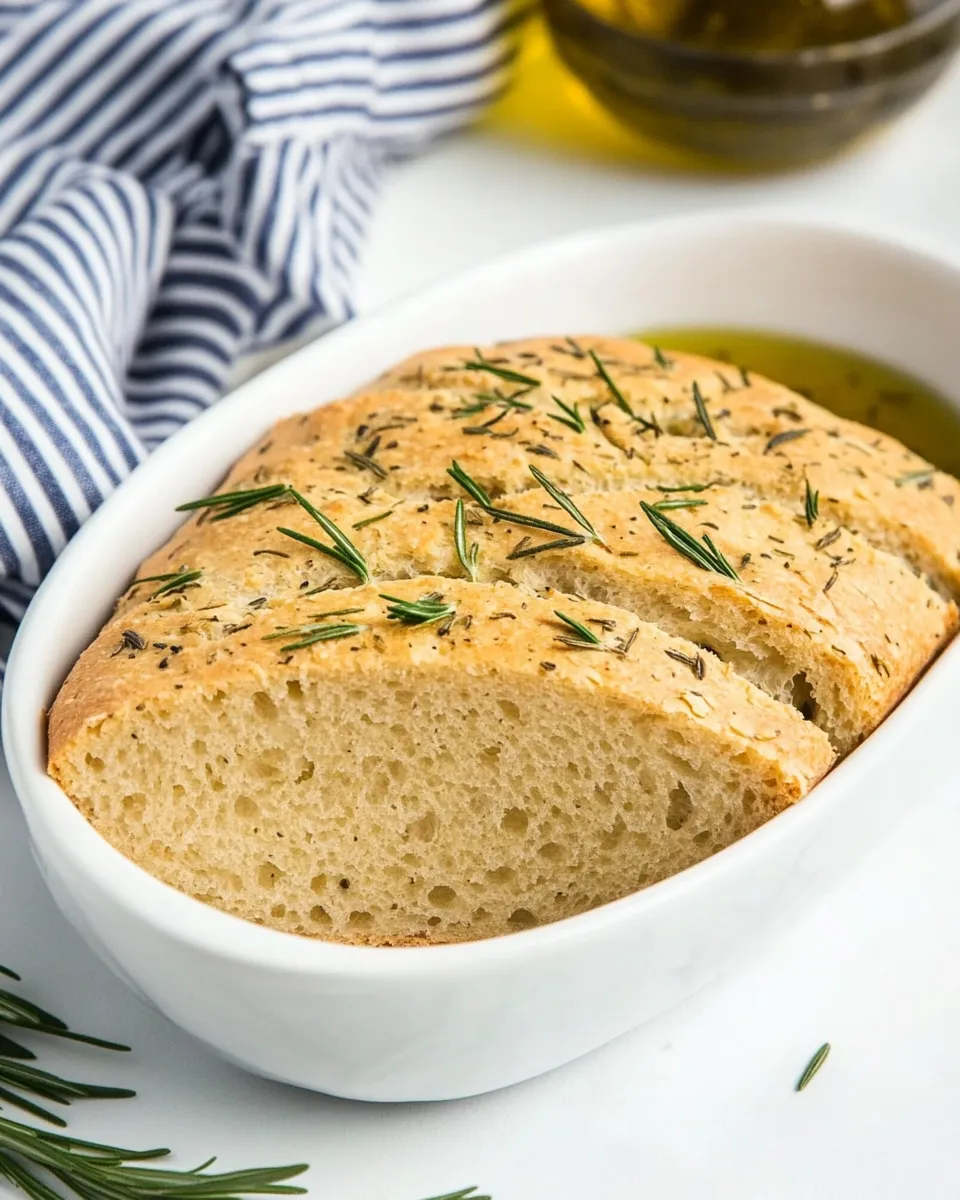
Rosemary Olive Oil Bread
A rustic olive oil bread flavored with fresh rosemary and a mix of whole wheat and all-purpose flours. Made with active dry yeast and finished with flaky sea salt.
Equipment
- Large Bowl
- Stand mixer
- dough hook
- Mixing Spoon
- Bench Scraper
- Parchment Paper
- Pizza stone
- Dutch Oven
- Oven
- Instant Read Thermometer
- Cooling rack
- Spatula
Ingredients
Ingredients
- 3/4 cupwarm water 100-110 F – I recommend taking the temp if you can!
- 1 tablespoonhoney
- 1 packetactive dry yeast1 1/4 ounces or 2 1/4 teaspoons
- 4 tablespoonsextra virgin olive oildivided
- 1 1/4 cupswhole wheat flour
- 1 1/4 cupsall-purpose flourplus extra for kneading
- 1 tablespoonvital wheat gluten*optional see notes
- 1 1/2 tablespoonschopped fresh rosemarydivided
- 1 teaspoonkosher salt
- 1/4 teaspoongarlic powder
- 1/4 teaspoondried oregano
- 1/4 teaspoondried basil
- 1/4 teaspoonfreshly ground black pepper
- Flaky sea saltsuch as maldon or fleur de sel
Instructions
Instructions
- In a large bowl or the bowl of a stand mixer fitted with a dough hook, combine 3/4 cup warm water (100–110°F), 1 tablespoon honey, and 1 packet active dry yeast (1 1/4 ounces or 2 1/4 teaspoons). Stir once, then let sit undisturbed for 10 minutes to proof. The mixture should become foamy; if it does not, the yeast is not viable or the water temperature was wrong and you will need to start over.
- After the yeast is foamy, stir in 3 tablespoons extra virgin olive oil.
- In a separate bowl, whisk together 1 1/4 cups whole wheat flour, 1 1/4 cups all-purpose flour, and 1 tablespoon vital wheat gluten (if using). Stir in 1 tablespoon chopped fresh rosemary, 1 teaspoon kosher salt, 1/4 teaspoon garlic powder, 1/4 teaspoon dried oregano, 1/4 teaspoon dried basil, and 1/4 teaspoon freshly ground black pepper.
- Add the dry ingredients to the bowl with the yeast mixture. Stir by hand with a sturdy spoon until a rough dough forms, or mix with the dough hook on low speed until the dough pulls together into a ball. If the dough seems dry and does not hold together, sprinkle warm water over the top 1 tablespoon at a time until it holds together in a rough ball.
- Turn the dough out onto a lightly floured surface (use extra all-purpose flour as needed for dusting). Lightly flour your hands and begin kneading.
- Knead the dough by hand for about 10 minutes, or mix with the dough hook for about 8 minutes on medium-low, until the dough is smooth, elastic, and tacky to the touch but not overtly sticky. If the dough is too sticky, add additional all-purpose flour 1 tablespoon at a time, kneading or mixing completely between additions.
- Lightly coat a clean bowl with nonstick spray or a thin film of olive oil. Place the kneaded dough in the bowl, turning once to coat the top with oil. Cover the bowl and let the dough rise in a warm, draft-free place until nearly doubled in size, about 1 to 2 hours. (If your kitchen is cool, allow more time.)
- When the dough has nearly doubled, prepare a sheet of parchment paper lightly dusted with flour. Do not punch the dough down. Turn the dough out onto the parchment.
- Lightly flour your hands. Stretch the top edge of the dough away from you and fold it up and toward the center. Repeat with the bottom, left, and right edges so the dough forms a rough square.
- Using a spatula, bench scraper, or your hands, flip the dough so the folded side is down. Cup your hands around the dough and tuck the edges under to form a smooth round ball. Place the round seam-side down on the parchment.
- Cover the dough with a clean towel and let it rise again in a warm, draft-free place until nearly doubled in size, about 1 to 2 hours more.
- When the second rise is nearly finished, place a pizza stone or a Dutch oven (with lid) in the oven and preheat the oven to 400°F with the stone or Dutch oven inside.
- If you will bake in a Dutch oven, trim two opposite sides of the parchment to create handles and trim around the parchment so you can lift the bread with a sling. If using a pizza stone, you can leave the dough on the parchment to transfer it.
- With a sharp knife or bread lame, score an “X” about 1/4 inch deep on the top of the loaf.
- Using the parchment, gently transfer the dough onto the preheated pizza stone or lower it (with the parchment sling) into the preheated Dutch oven. Bake for 10 minutes.
- After 10 minutes, remove the bread from the oven. Brush the top with the remaining 1 tablespoon extra virgin olive oil, sprinkle the remaining 1/2 tablespoon chopped fresh rosemary evenly over the top, and add a pinch (or to taste) of flaky sea salt.
- Return the bread to the oven and bake 10 to 15 minutes more, until the internal temperature reaches 195°F on an instant-read thermometer. If you do not have a thermometer, the loaf should be golden brown and sound hollow when tapped on the bottom. If the crust is browning too quickly, loosely tent the loaf with foil.
- Remove the bread from the oven and transfer to a cooling rack. Let cool to almost room temperature before slicing and serving.
Notes
Vital wheat gluten can be added to yeast breads that are made with whole-wheat flour to help them rise more effectively. Gluten is responsible for the stretchiness of dough and for the shapes that baked goods hold. Since whole-wheat flour is heavier than its white counterparts the vital gluten gives it an extra boost to create a lighter, fluffier loaf.
Look for vital wheat gluten in the baking aisle of larger grocery stores or any specialty food store or you can find it onlinehere. You may also omit the vital gluten from the recipe entirely with good results.
TO STORE. Nothing beats fresh bread the day it is baked, but you can store leftover homemade bread at room temperature, wrapped tightly in plastic wrap or in a ziptop bag, 4 days.
TO REHEAT. Place slices in the toaster, or rewarm in a 300 degree-F oven for 5 to 10 minutes.
Look for vital wheat gluten in the baking aisle of larger grocery stores or any specialty food store or you can find it onlinehere. You may also omit the vital gluten from the recipe entirely with good results.
TO STORE. Nothing beats fresh bread the day it is baked, but you can store leftover homemade bread at room temperature, wrapped tightly in plastic wrap or in a ziptop bag, 4 days.
TO REHEAT. Place slices in the toaster, or rewarm in a 300 degree-F oven for 5 to 10 minutes.