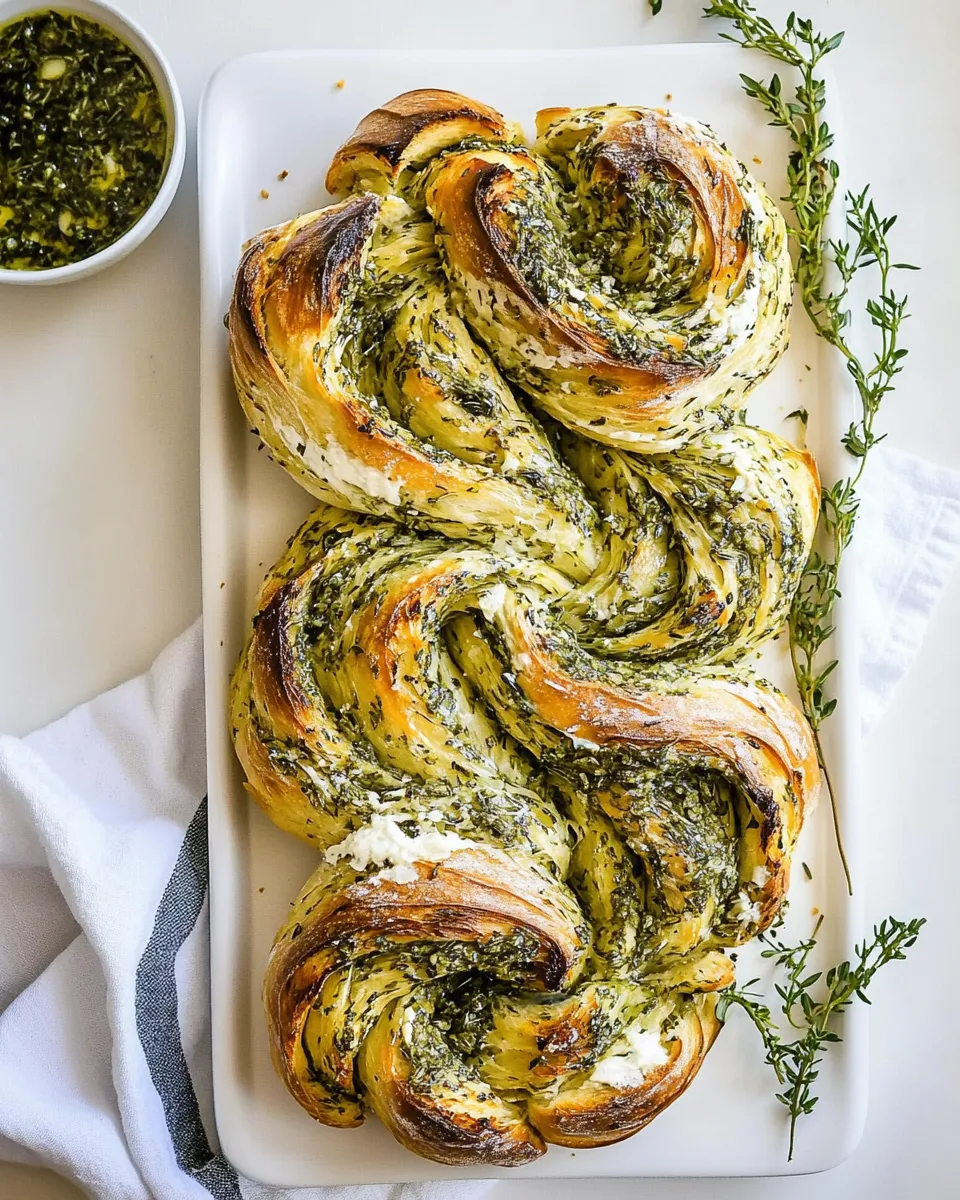
Swirled Garlic Herb Bread.
A soft, swirled yeast bread filled with a garlic-parmesan herb butter for slicing and serving warm.
Equipment
- Stand mixer with dough hook
- Small Bowl
- parchment-lined baking sheet
- Sharp Knife
- plastic wrap or clean kitchen towel
- Oven
Ingredients
Ingredients
- 3/4 cupwarm whole milk
- 2 1/4 teaspoonsinstant yeast
- 2 tablespoonshoney
- 3 large eggs
- 3 1/2 – 4 cupsall-purpose flour plus more for rolling
- 1 teaspoonkosher salt
- 6 tablespoonssalted butter at room temperature, plus more for serving
- 1-2 clovesgarlic grated or finely chopped
- 1/4 cupfreshly grated parmesan cheese
- 1/2 cupfresh basil finely chopped
- 2 tablespoonschopped fresh thyme
- 1 tablespoonchopped fresh sage
Instructions
Instructions
- In the bowl of a stand mixer fitted with the dough hook, combine 3/4 cup warm whole milk, 2 1/4 teaspoons instant yeast, 2 tablespoons honey, 3 large eggs, 3 1/2 cups all-purpose flour, and 1 teaspoon kosher salt. Mix on low/medium speed until the flour is completely incorporated, about 4–5 minutes.
- Add 2 tablespoons of the room-temperature salted butter and mix on low/medium speed until the butter is incorporated and the dough becomes smoother, about 2–3 minutes. If the dough is still sticky, add up to the additional 1/2 cup flour (a little at a time) until the dough is soft, smooth, and only slightly tacky to the touch.
- Form the dough into a ball, cover the bowl with plastic wrap (or a clean kitchen towel), and let the dough rise in a warm, draft-free place until doubled in size, about 1 hour.
- While the dough is rising, make the garlic-herb butter: in a small bowl combine the remaining 4 tablespoons room-temperature salted butter, 1–2 cloves garlic (grated or finely chopped, use your preferred amount), 1/4 cup freshly grated Parmesan cheese, 1/2 cup finely chopped fresh basil, 2 tablespoons chopped fresh thyme, and 1 tablespoon chopped fresh sage. Stir until evenly mixed and set aside.
- After the dough has doubled, punch it down to release the gas. Turn it out onto a lightly floured surface and roll it into a rectangle about 12 x 18 inches, using additional flour as needed to prevent sticking.
- Spread the garlic-herb butter evenly over the entire surface of the rolled dough, leaving a small margin (about 1/4 inch) along one long edge.
- Starting with the long edge closest to you, tightly roll the dough into a log lengthwise. Pinch the seam and the ends to seal.
- Place the log seam-side up on the work surface. Using a sharp knife, cut the log lengthwise down the middle to create two long ropes, leaving about 1 inch uncut at one short end so the two ropes remain attached there.
- Turn each rope so the cut/filling sides face up. Cross the two ropes over each other and twist them together along the length, keeping the cut sides exposed as you braid/twist until you have one long twisted rope.
- Coil the twisted rope into a round loaf by coiling one half of the rope into a spiral in one direction and coiling the other half into a spiral in the opposite direction so the two spirals meet in the center. Tuck or pinch the ends under to help the loaf hold its shape.
- Transfer the coiled loaf to a parchment-lined baking sheet. Cover loosely with plastic wrap or a clean towel and let rise in a warm place for about 45 minutes, until puffy.
- While the loaf is finishing its final rise, preheat the oven to 350°F (175°C).
- Bake the bread in the preheated oven for 30–35 minutes, until the top is golden brown and the loaf sounds hollow when tapped or is cooked through.
- Remove the bread from the oven and immediately brush the top with additional butter (use the "plus more for serving" butter listed in the ingredients). Let the loaf rest a few minutes, then slice and serve warm.
Notes
Notes
To Make Ahead:
prepare the bread through step 6. Once the bread is shaped, place it on a parchment lined baking sheet, cover, and place in the fridge for up to 2 days. When ready to bake, remove the bread from the fridge 1 hour prior to baking, then bake as directed.
To Freeze:
bake the bread as directed and allow to cool completely. Once cool, wrap the bread tightly with plastic wrap, then transfer to a freezer safe container. Freeze for up to 3 months. Thaw on the counter and warm or toast before serving.
Leftovers:
the bread is best served warm after baking, but the leftover bread is delicious when lightly toasted or served at room temperature.
To Make Ahead:
prepare the bread through step 6. Once the bread is shaped, place it on a parchment lined baking sheet, cover, and place in the fridge for up to 2 days. When ready to bake, remove the bread from the fridge 1 hour prior to baking, then bake as directed.
To Freeze:
bake the bread as directed and allow to cool completely. Once cool, wrap the bread tightly with plastic wrap, then transfer to a freezer safe container. Freeze for up to 3 months. Thaw on the counter and warm or toast before serving.
Leftovers:
the bread is best served warm after baking, but the leftover bread is delicious when lightly toasted or served at room temperature.